
The Strategic Plan
St. Veronica’s Comprehensive School 2025-2029 Strategic Plan is the first such formal strategic plan developed. The main aim of the Plan is to articulate our priorities and focus our energies and scarce resources towards attaining desired outcomes. This Plan is also developed at a time when there is increased demand for quality education and good values from stakeholders, following the introduction Competency Based Curriculum (CBC).
The Mandate of the school and its main functions are as defined by the Basic Education Act (No. 14 of 2013) of the laws of Kenya, the Teachers Service Commission Act (No. 20 of 2012) and Regulations, and relevant policies. The core business is therefore as follows:
- Curriculum implementation: teaching and learning.
- Academic Teaching and passing skills and knowledge to learners.
- Promoting educational activities in the school environment
- Creating a safe and secure environment for teaching and learning
- Assessment: Administration of tests and examinations
- Administration and management of Educational programs in school with assistance of Board of Management and the Parents-Teachers Association (PTA)
Purpose and Justification of the strategic plan
The purpose of this plan is:
- To provide strategic direction for the School.
- To provide an open, transparent and a consultative framework for running of the School.
- To coordinate efforts, create a basis for resource mobilization, allocations and focus in the attainment of the set targets.
- To enable the school to align strategic objectives with financial and human resources.
- To provide a basis for short term and long-term evaluation of plans and funding.
Compliance with the Constitution of Kenya 2010 and Legal Mandate
Chapter 4 of the Constitution of Kenya 2010, on bill of rights bestows extensive rights to citizens. Access to educational services, for example, are increasingly being enabled by ICT technologies. In compliance to this, this Strategic Plan is will ensure application and use of ICT services in teaching and learning.
Specific attention is paid to Article 53 of the Constitution and other enabling provisions; to promote and regulate free and compulsory basic education; to provide for accreditation, registration, governance and management of institutions of basic education; to provide for the establishment of the National Education Board, the Education Standards and Quality Assurance Commission, the County Education Board and for connected purposes.
In the development of this Strategic Plan, attention has also been paid to provision of Article: 27 – equality and freedom from discrimination; Article: 35, on right of access to information; Article:42, on right to a clean and healthy environment; and Article: 43, on economic and social rights, among other rights.
Methodology
Section 59 of the Basic Education Act 2013 requires the Board of Management of every public school develop a Strategic Plan for the institution, laying out its goals, development plans and resource generation plans. Pursuant to this legal requirement, the BoM of St. Veronica’s Comprehensive School initiated this process and developed a draft consultation document.
This draft was discussed internally and thereafter subjected to stakeholder consultation. A stakeholder’s analysis was done and participants selected from amongst Parents, Community leaders, government administrators, public health authorities, teachers’ from neighboring schools, retired teachers, head teachers, spiritual leaders, and learners’ representatives, among others.
The draft document developed by the Board was presented to the above stakeholders in a Stakeholders’ workshop was held on 27th July 2024. The Stakeholders’ inputs were incorporated in the final document.
Organization of this Strategic Plan
This strategic plan is organized in eight Chapters, as follows:
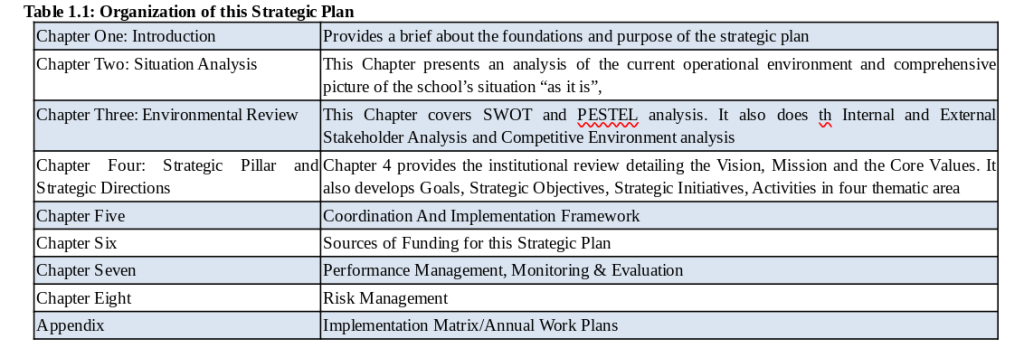
This Strategic Plan has six (6) goals and fourteen (14) Strategic Objectives. The Fourteen Strategic Objectives are grouped in four (4) thematic areas, also called Strategic Pillars in this document.
The four thematic areas are as follows:
- Academic Excellency and Learners Development,
- Institutional Culture and Environment,
- Infrastructure Development & Operational efficiency,
- Human and Financial Resource Management and Partnerships
Expectations of this Plan
This Plan addresses the following expectations:
- Improving quality of education and performance;
- Introduction of new teaching products like French and Sign Language, that will provide learners more opportunities and competitive advantage in the job market;
- Application of ICT and other technologies in the teaching and learning processes, and in school management;
- Expansion of available physical facilities;
- Improvement of the physical environment, support for Environmental Conservation and Mitigation against the negative effects of Climate Change;
- Promotion of culture, sports and other extra-curricular activities within the school;
- Creating efforts to attract and retain both staff and learners
- Create an alternative income generating facility that shall help impact alternative Agri-business skills and entrepreneurship to the school and the community;
- Ensure sense of discipline and integration of good values to learners to develop an value based institutional culture.